
 +155 545 10 467



Where is capital going around NEOM’s headline project, and what can an outside investor actually reach? Since April 2026 the answer has shifted. Public Investment Fund (PIF) leadership described a reprioritization of NEOM, Semafor reported in May 2026 that work on The Line was halted until after 2030, and the port, hydrogen and AI infrastructure at Oxagon kept moving. Based on our research, the five-part comparison below sorts those projects by delivery evidence and investor access rather than by headline size.
The five investment opportunity clusters to monitor around The Line are Port of NEOM logistics, Oxagon industrial development, green hydrogen infrastructure, AI data centers and The Line’s future urban-development phases. As of November 2026, capital commitments and construction progress are more visible around Oxagon than along The Line itself. These are investment themes, not five verified property-sale zones.

Where Is Capital Flowing Around The Line?
The five clusters in this article are editorial analytical categories, not five officially designated geographic investment zones. Four of them (Port of NEOM logistics, Oxagon industrial development, green hydrogen infrastructure and the Oxagon AI data center campus) are associated with Oxagon, NEOM’s industrial city on the Red Sea coast. Only the fifth cluster concerns The Line itself. We compare evidence strength and access, not capital totals, because the public figures measure different things: a financed project budget, a planned megawatt target and a memorandum of understanding cannot be added together. The order below is an editorial comparison, not a league table of spending.
| Opportunity cluster | Actual location | Latest verified milestone | Type of capital evidence | Plausible participation route | Present accessibility | Principal risk and research assessment |
|---|---|---|---|---|---|---|
| 1. Port of NEOM logistics | Oxagon, Red Sea coast of NEOM (not on The Line) | European multimodal corridor announced April 14, 2026; logistics memorandum with CEVA Almajdouie dated October 14, 2026 | Operating-service announcements and a memorandum; no disclosed asset valuations | Freight, trucking, customs and warehousing services; invited infrastructure partnerships | Open to operating companies in principle; terminal assets not publicly offered | Volume dependence and capacity delivery. Moderate-to-strong evidence of operations; medium-term horizon tied to service contracts. |
| 2. Oxagon industrial and manufacturing sites | Oxagon, 48 km² core development area | Official 48 km² core area description; no verified plot inventory in the sources reviewed | Official project description; individual industrial agreements not consolidated publicly | Land allocation or lease, operator licence, supply contracts | Case-by-case for business entrants; not a property-sale market | Utilities, demand and allocation terms. Moderate evidence; horizon depends on each operator’s build-out. |
| 3. Green hydrogen and energy infrastructure | NGHC facility at Oxagon | Construction reported complete and commissioning under way (MEED, August 14, 2026); commercial operation targeted for 2027 | Financial close in 2023; construction spending; offtake agreement | Joint-venture equity held by the three partners; supplier and contractor roles | Not open to outside equity on public evidence | Commissioning, operating and offtake-counterparty risk. Strong evidence of construction; operations unproven. |
| 4. Oxagon AI data center infrastructure | Oxagon, HUMAIN–DataVolt AI campus | Construction announced August 31, 2026 (100 MW within a 360 MW first phase); preliminary framework for up to 50 MW dated October 21, 2026 | Construction start and a preliminary customer framework; no reported revenue | Capacity customer, equipment or service supplier | Open to customers and suppliers; developer equity not publicly offered | Power, financing and demand timing. Moderate evidence; horizon runs to the 2027–2028 delivery windows reported. |
| 5. The Line future urban development | The Line corridor, inland in northwestern NEOM | Reprioritization stated in April 2026; work reported halted until after 2030 (Semafor, May 2026) | Masterplan only; no verified funded sale phase | None verified | Not accessible; monitor-only | Delay, title and funding risk. Weak delivery evidence; horizon cannot be estimated. |
Oxagon currently has more publicly documented industrial implementation than The Line’s proposed residential development. A common misunderstanding we see: investors read “NEOM” as a single asset, so a milestone at the port or hydrogen plant gets treated as progress on The Line. The two sit in different parts of the NEOM region and have different owners, funding and delivery records.
Sector clustering also does not prove access. A hydrogen plant under commissioning shows that capital was spent and a facility was built, but it does not show that an outside investor can buy a stake. The sections that follow state what each cluster offers, what remains unverified and which evidence would change the classification.
The Line and NEOM: What Is Actually Being Developed?
NEOM is the regional giga-project in northwestern Saudi Arabia, under Saudi Vision 2030, and The Line is only one of its components. In April 2026 the PIF governor addressed what he called a common misconception that The Line represents the whole of NEOM, according to Eye of Riyadh’s report of his Al Arabiya interview. Oxagon, by contrast, is the industrial city on the Red Sea coast, anchored by the Port of NEOM. The three terms therefore describe a region, a linear city concept and an industrial city, and they should not be used interchangeably.

Original vision versus current phase
The Line was unveiled in January 2021 as a linear city 170 km long and 200 m wide. In 2024, media coverage reported that the near-term target had been cut to an initial section of roughly 2.4 km. Those two figures describe a concept and a reduced early-stage scope; neither is evidence of completed urban inventory.
The original timetable was tied to a 2030 horizon. At the April 2026 PIF strategy announcement, the PIF governor said no NEOM project had been cancelled but that projects were being reprioritized, and a Skift report quoted him on The Line: “It’s good to have, but it’s not a must-have.” Semafor then reported on May 22, 2026, citing anonymous sources, that NEOM had halted work on The Line until after 2030, and NEOM had not responded when that report was published. As of November 2026, the official position (reprioritized, not cancelled) and the independent report (halted until after 2030) have not been reconciled by any published NEOM schedule. NEOM’s current public descriptions frame development as phased and demand-led, and we recommend checking the exact wording on NEOM’s own pages because it has changed more than once.
Why proximity to The Line does not establish ownership rights
Oxagon, its port and its industrial projects are not sections of The Line. Being in the same region creates no property right, no shared title and no entitlement to any infrastructure revenue. We found no verified public map showing five saleable real estate districts along The Line, and we do not treat any such map as established unless a credible source shows the legal boundaries, the owner and the release terms.
Zone 1: Port of NEOM Logistics Investment
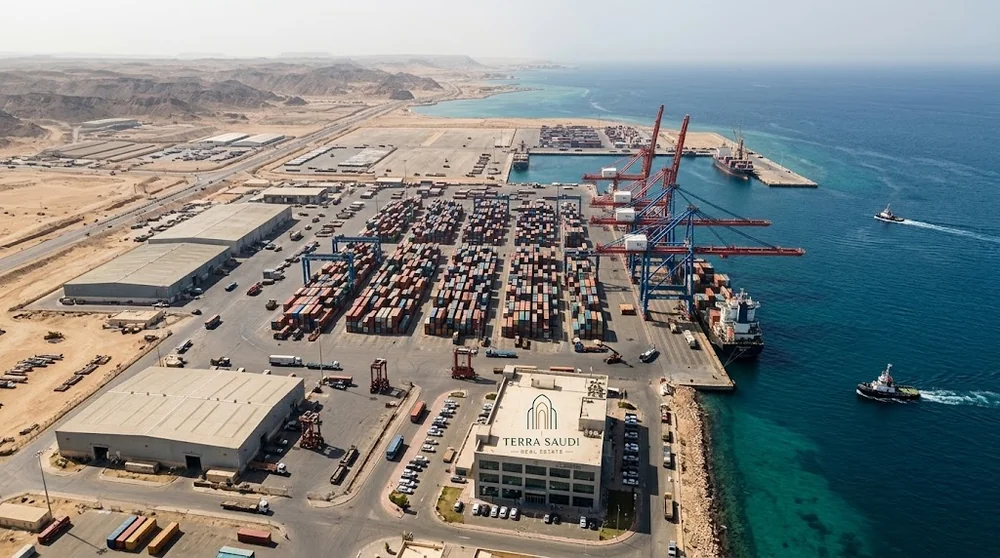
Port of NEOM is the most operationally advanced cluster in this comparison, and it sits at Oxagon on the Red Sea coast, not on The Line. Announced is not the same as delivered — here’s the difference: some Port of NEOM services are running today, while the large container-terminal capacity figures remain targets.
Operational evidence
NEOM’s own release of April 14, 2026 states that Port of NEOM, together with Pan Marine and with support from DFDS, enabled a multimodal corridor linking Europe, Egypt, NEOM and the GCC. Pan Marine had launched its RoPax service between Safaga and Port of NEOM at the end of 2025, and the release says European connectivity was activated at the end of March 2026. These are existing services, and they should be separated from future capacity.
On capacity, NEOM’s port page describes a new container terminal launching in 2026 with 1.5 million TEU capacity, while NEOM’s Oxagon page gives 1.5 million TEU by 2030. We could not verify that the terminal has been commissioned, so we treat 1.5 million TEU as a target. The memorandum between Port of NEOM and CEVA Almajdouie Logistics, dated October 14, 2026, covers exploring integrated logistics across the Europe–Egypt–Saudi Arabia–GCC–Iraq corridor. Container News noted that the announcement did not specify new scheduled services, additional capacity or a timetable.
Possible investment routes
Realistic participation routes are commercial: freight forwarding, trucking, customs brokerage, bonded warehousing, vessel and ferry operations, equipment supply and, for qualified institutions, infrastructure partnerships by invitation. Land or terminal ownership is not automatically on offer, and we found no public evidence that terminal assets or port-adjacent plots are being sold to private investors. We recommend checking whether any offer you receive names the legal owner of the asset and the contractual basis of your rights.
Principal risks
Demand dependence is the central risk, because the corridor economics rely on freight volumes that no public source has yet published. Delivery risk covers the terminal upgrade and the inland connections: MEED reported on September 15, 2026 that NEOM plans an Oxagon freight rail connection with the SAR network, which is a plan rather than a built link. Regional security events reported by MEED in September and October 2026 add a trade-flow risk that sits outside any single project.
Zone 2: Oxagon Industrial Investment Opportunities
Oxagon’s official description gives a 48 km² core development area, anchored by an operating port on the Red Sea and oriented toward renewable-energy and AI-driven industries. The same NEOM page lists Oxagon Hive, an early community with capacity for up to 2,400 people alongside commercial spaces. Those are the verified anchors; we did not find a public register of available industrial plots, and we do not assert that any are open for allocation.
Four different things are often confused here. A land allocation or lease gives an operator the right to use a site under agreed terms. Industrial-operator participation means running a plant or service. Business licensing is the permission to operate, handled for foreign-owned businesses through the Ministry of Investment of Saudi Arabia (MISA). Private real estate ownership is a separate legal right. The clearest documented example of the lease model is the AI campus, where DataVolt was reported by Data Center Dynamics to lease its land from Oxagon rather than buy it.
Public evidence of industrial activity at Oxagon is concentrated in the port, the hydrogen plant and the data center campus covered in the other sections. Wider manufacturing agreements exist in NEOM announcements, but we could not consolidate them into a verified list of operating plants, so we do not present one.
Dependencies decide feasibility. An industrial tenant needs reliable power and water, port and rail access, a customer base for what the plant produces and the permits for its activity. Commercial feasibility checks should be done per project: who the offtaker is, who supplies the utilities and what happens to the lease if NEOM changes priorities.
Our assessment (editorial opinion): industrial participation at Oxagon is closer to an operating business decision than to a property purchase. A residential unit on The Line asks you to bet on a city; an industrial lease at Oxagon asks you to assess a plant, a customer and a utility connection, which are easier to verify.
Compared with residential speculation, industrial investment has a shorter chain of dependencies but a narrower set of eligible participants. Both require documentary proof of the right being sold.
Zone 3: Green Hydrogen and Energy Infrastructure
The NEOM Green Hydrogen Company (NGHC) project is the largest single reported capital figure in this article, and it also has the clearest delivery milestone. MEED reported on August 14, 2026 that construction on the approximately USD 8.5 billion project at Oxagon is complete and that the facility has entered commissioning, with commercial operation targeted for 2027. MEED attributed the status to the Acwa CFO on the company’s H1 2026 earnings call. Early financing materials from 2023 cited USD 8.4 billion, and later media used USD 8.5 billion, so we describe the budget as approximately USD 8.4–8.5 billion.
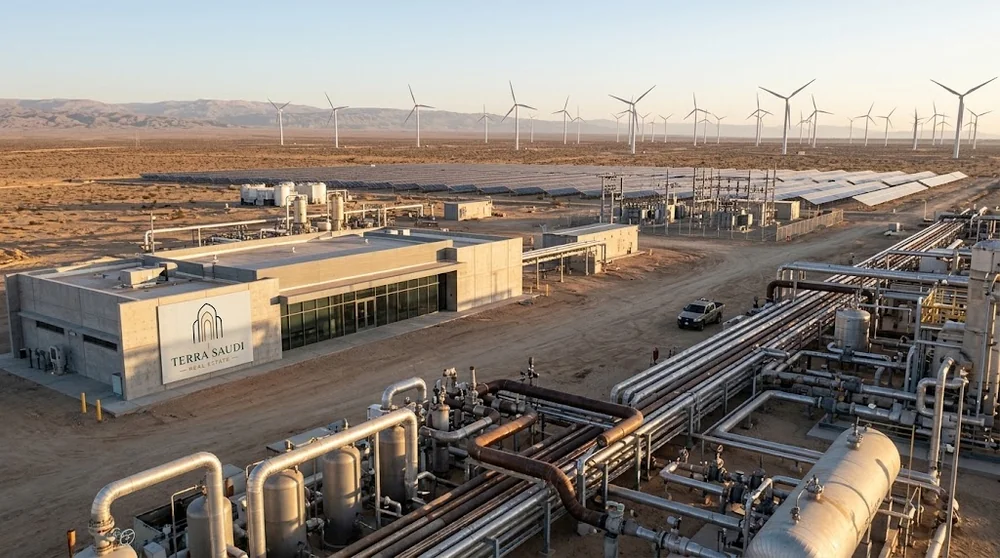
Three states must stay separate. Construction complete is a reported fact as of August 2026. Commissioning is the ongoing testing stage. Commercial operation in 2027 is a company target, not an achieved result. NGHC is an equal joint venture of ACWA Power, Air Products and NEOM, reached financial close in 2023, and, per MEED, Air Products is the exclusive offtaker of the green ammonia under a 30-year agreement. The facility is expected to produce up to 1.2 million tonnes a year of green ammonia for export once operating.
A joint venture, an offtake arrangement and a finished facility do not automatically give outsiders an investment vehicle. The equity sits with three named partners, the output is contracted to one offtaker, and the 2023 financing was non-recourse debt from banks and investment firms. We found no public offer of NGHC equity to outside investors. Realistic exposure for other parties comes through supply and service contracts, or indirectly through Saudi-listed Acwa, whose shares carry the risk of a diversified power company rather than a clean exposure to NEOM hydrogen.
Our assessment (editorial opinion): the hydrogen plant is the strongest proof that capital reached Oxagon, but it is the weakest proof of investor access. A completed plant tells us the money was spent; it does not tell us anyone else may join.
The main risks are technology at scale (the plant depends on 4 GW of wind and solar and large electrolyzers working together), commissioning delays, cost overruns, variable renewable supply and counterparty concentration in a single offtaker. We recommend checking whether any hydrogen-linked opportunity names the legal entity, its role in the NGHC structure and the contract that gives you a right to revenue.
Zone 4: Oxagon AI Data Center Investment
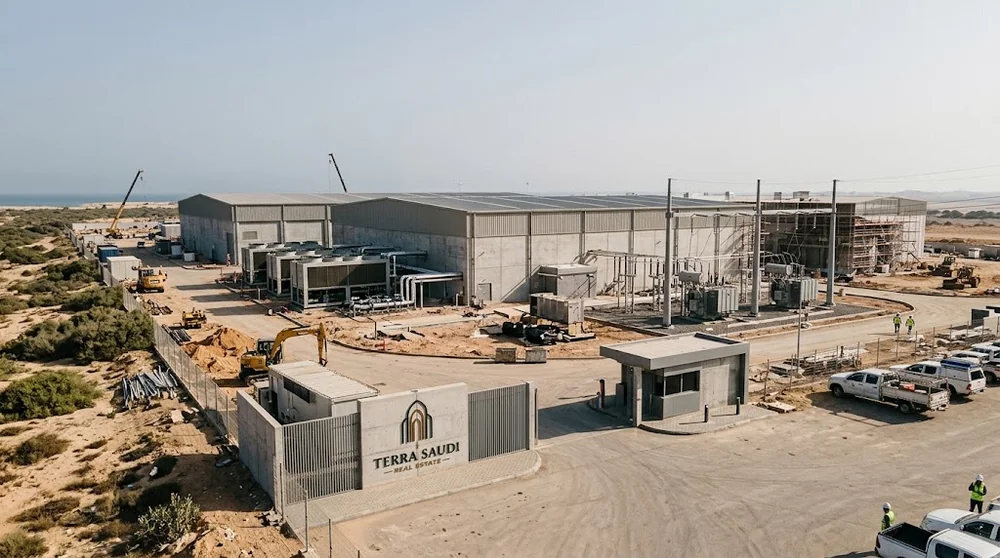
The Oxagon AI campus is the newest of the four Oxagon clusters, and its figures nest inside one another, so each layer must be read separately. On August 31, 2026, NEOM, HUMAIN (a PIF company) and DataVolt announced at LEAP that construction was under way on 100 MW within a 360 MW first phase of DataVolt’s planned AI campus at Oxagon. Reuters reported the first phase as part of a wider planned 1.5 GW campus.
Verified capacity milestones
Four layers apply as of November 2026. Under construction: 100 MW. Planned first phase: 360 MW. Broader campus ambition: 1.5 GW. Preliminary customer framework: up to 50 MW, announced on October 21, 2026 with Nebius, named as an anchor customer; trade reporting describes the capacity as arriving in phases from the fourth quarter of 2027. MEED and Data Center Dynamics reported that the first 100 MW is expected to be available in 2028. The two releases use different timing language, and the coverage we reviewed does not explain the difference.
A preliminary framework is not a binding capacity contract. Planned megawatts are not delivered capacity, and delivered capacity is not revenue. We found no reported operating revenue and no confirmed total capital cost for the campus from the project companies.
Investor and supplier exposure
Exposure comes in three forms: customers that contract capacity, suppliers of electrical, cooling and network equipment, and financiers lending to the developer. DataVolt develops, owns and operates the campus, and Data Center Dynamics reported that Oxagon leases the land to DataVolt. We found no public route for outside investors to buy campus equity, so developer-level ownership should be treated as unavailable unless a documented offer proves otherwise.
Execution risks
AI campuses are capital-intensive and depend on stable power, cooling, high-capacity network connectivity and chip supply. Data Center Dynamics reported that the site is to be powered by NEOM’s wind and solar assets, so the power plan depends on those assets operating as designed. Financing risk, customer-concentration risk (a single anchor customer) and construction-schedule risk remain open until the first capacity block is live and billing.
Zone 5: The Line Future Urban Investment
The Line’s future residential, mixed-use and commercial projects are a set of conditional scenarios, not current offerings. A project could become investable only if a specific phase were formally funded, permitted, released for sale or lease and legally transferable to the buyer. As of November 2026, we found none of those four conditions publicly evidenced for any phase of The Line.
The 2026 reprioritization makes that gap wider. At the April 2026 PIF strategy announcement the governor said no NEOM project had been cancelled while priorities were reordered, and Skift reported that construction commitments had been cut by tens of billions. Semafor’s May 22, 2026 report, based on anonymous sources, said work on The Line was halted until after 2030 and tied that to a shift of spending toward infrastructure such as ports and data centers. Neither the PIF remarks nor the Semafor report is a published construction schedule, and Semafor’s account is not an official confirmation.
A masterplan does not establish construction completion, property transferability or rental yields. A rendering shows intent; it does not show who owns the land, who pays for the structure or who will lease the units. We do not supply property prices, yields or delivery dates for The Line because no verified source provides them.
Our assessment (editorial opinion): The Line should be classified as monitor-only. Capital committed elsewhere in NEOM is real, but none of it is evidence of a purchasable unit in the linear city.
Scenarios help readers decide what to watch. If a funded phase is announced with named contractors, a legal release mechanism and a published eligibility route, the opportunity would move from monitor-only toward diligence. If an agent offers a “pre-launch” unit before any of these exist, the offer is speculative marketing until the seller proves otherwise. We recommend treating any such offer as unverified until the checks in the verification section are complete.
Which NEOM Investment Clusters Are Most Accessible?
Accessibility differs by investor type, and committed funding differs from publicly purchasable assets. The table below separates what we observed from what remains unverified, and the status reflects our research as of November 2026.
| Investor profile | Possible exposure | Legal or commercial requirements | Observed availability | Unverified availability | Next verification step |
|---|---|---|---|---|---|
| Individuals seeking real estate | Residential units or land | Eligibility under the non-Saudi ownership law; registered title | None found for The Line or Oxagon | Any “pre-launch” offer or land parcel | Ask for the title record and REGA eligibility confirmation |
| Corporate strategic investors | Joint ventures, anchor-customer roles | MISA licensing; partner approval | Existing JV structures (hydrogen) and customer frameworks (data center) | New JV slots | Contact the project company directly and request the term sheet |
| Infrastructure funds | Project debt or equity | Institutional diligence; counterparty approvals | Financing closed for hydrogen in 2023 | Equity or debt in later phases | Request financing documents and lender list |
| Operating companies | Business establishment, leases, service contracts | MISA license; lease or allocation terms | Port logistics services; Oxagon industrial activity | Specific plots or units | Request the lease form and utility commitments in writing |
| Suppliers and contractors | Equipment, services, construction packages | Prequalification with the developer or contractor | Active procurement on hydrogen and data center work | Future packages for The Line | Confirm the buyer’s identity and payment security |
Five different measures are often presented as the same thing, and the definitions below keep them apart.
- Capital commitment: a stated intention or pledge to spend, which may not be binding.
- Financial close: the point at which lenders and equity holders have signed and funding is available, as NGHC reported in 2023.
- Signed offtake: a contract for a buyer to take output, such as the 30-year Air Products agreement.
- Construction spending: money actually spent on building, which no source in our review publishes in full.
- Operating revenue: cash earned from live operations, which no Oxagon cluster has yet reported.
- Available equity: a stake that an outsider can legally buy, which we could not verify in any cluster.
Our editorial accessibility ranking for operating businesses and suppliers, which is not a quantitative capital-flow ranking and uses no transaction data, runs as follows.
- Port of NEOM logistics, because services are operating and business participation is the clearest.
- Oxagon AI data centers, because customer and supplier roles are visible and the project is under construction.
- Oxagon industrial sites, because participation is plausible but plot availability is unverified.
- Green hydrogen, because the facility exists but equity and offtake sit with named partners.
- The Line urban development, because no accessible asset has been verified.
Can Foreigners Buy Property in NEOM?
Saudi Arabia’s Law of Real Estate Ownership by Non-Saudis (Royal Decree No. M/14, published in the Official Gazette on July 25, 2025) entered into force on January 22, 2026, as reported by Argaam and law-firm summaries. The law replaced the 2000 framework and allows non-Saudi individuals and entities to own real estate or acquire other registrable real rights, within a geographic-scope model that the Real Estate General Authority (REGA) administers. Ownership or real rights acquired by non-Saudis take effect only upon registration in the national Real Estate Registry, and REGA can charge a disposal fee of up to 5% on non-Saudi acquisitions under the law, according to law-firm commentary as of January 2026.
Four features matter for NEOM. First, geography: ownership is tied to areas designated through the Council of Ministers and published by REGA, and the examples given in law-firm summaries are zones in Riyadh, Jeddah, Makkah and Madinah. We have not verified that any NEOM location is inside a designated area as of November 2026, so we do not assert one. Second, applicant category: individuals, companies and certain capital-market entities fall under different rules, and law-firm commentary reports that foreign-owned Saudi companies may hold property needed for licensed activities. Third, rights: full ownership, usufruct and other real rights are different instruments. Fourth, a narrow exception reported by MEED on April 9, 2026 allows some non-Saudi residents to own one residential property outside designated areas. That exception comes with conditions and does not mean NEOM parcels qualify.
The law’s entry into force does not mean any investor can buy anywhere in NEOM. Land in a giga-project area also raises a separate question of who holds the title and who is allowed to transfer it, which the foreign-ownership law does not answer by itself. For a business investor, the Ministry of Investment of Saudi Arabia (MISA) handles licensing of foreign-owned activities, and the Zakat, Tax and Customs Authority (ZATCA) administers applicable transaction taxes, whose rates should be confirmed as of the transaction date.
If you hold an offer describing NEOM land or a future unit and are unsure which documents your situation requires, a short one-to-one conversation before any deposit can save a costly mistake.
Whatever the answer to your specific case, the sequence of checks below applies to any NEOM property offer. We recommend checking each item in writing and consulting a qualified Saudi legal professional.
- Identify the exact asset and its legal description, and compare it with REGA’s published geographic scope for non-Saudi ownership.
- Confirm your applicant category (resident or non-resident individual, company or fund) and the rules that apply to it.
- Establish which right is being offered: full ownership, usufruct or another real right.
- Search the asset’s record on the Saudi Properties portal and in the Real Estate Registry, and confirm that registration will be completed in your name.
- Obtain the seller’s chain of title and written proof that the seller is authorized to transfer the right.
- If a business purpose is involved, confirm the MISA license and the permitted activity.
- Calculate transaction costs, including the REGA disposal fee and ZATCA taxes, as of the transaction date.
- Insist on escrow or staged payments that release funds only against registered milestones.
- Have an independent Saudi lawyer review every document before any payment.
The Line Construction Timeline and Capital Commitments
The table below reconciles the original plans, the 2026 statements and the independent reporting in one sequence. Each entry is classified by source type and delivery status, so that official statements and external reporting are not mixed.
| Date | Event | Source type | Delivery status | Investor implication |
|---|---|---|---|---|
| January 2021 | The Line concept unveiled at 170 km length | Official announcement | Announced | A concept, not inventory |
| 2023 | NGHC reaches financial close on the hydrogen project (USD 8.4 billion in financing materials) | Company statement | Financed | Funding secured; no outside equity route shown |
| April 2024 | Reported reduction of The Line’s initial scope to about 2.4 km | External reporting | Announced (revised) | Scope is smaller and unbuilt |
| End of 2025 | Pan Marine RoPax service between Safaga and Port of NEOM launched | NEOM release (April 2026) | Operating | Early logistics revenue possible |
| January 22, 2026 | Non-Saudi ownership law enters into force | Regulator announcement and law-firm summaries | In force | Eligibility still depends on designated areas |
| April 14, 2026 | Europe–Egypt–NEOM–GCC multimodal corridor announced | NEOM release | Operating service | Existing service, not future capacity |
| April 15, 2026 | PIF 2026–2030 strategy approved; governor says no NEOM project cancelled, priorities reordered | Official statement via media | Reprioritized | The Line is not a stated near-term priority |
| May 22, 2026 | Semafor reports work on The Line halted until after 2030 | External reporting (anonymous sources) | Reported delayed | Treat as unconfirmed by NEOM |
| August 2026 | Hydrogen construction reported complete; commissioning under way; 2027 operation targeted | Company earnings call, reported by MEED | Commissioning | Operation not yet achieved |
| August 31, 2026 | HUMAIN and DataVolt start 100 MW within a 360 MW first phase | NEOM and company release | Under construction | No revenue; capacity expected 2028 |
| October 14, 2026 | Port of NEOM and CEVA Almajdouie memorandum | Company announcement | Announced (preliminary) | Exploratory; no timetable stated |
| October 21, 2026 | Preliminary framework for up to 50 MW with Nebius | NEOM and company release | Preliminary agreement | Not a binding capacity contract |
| November 2026 | Research cutoff: no verified announcement of purchasable inventory at The Line found | Our research | Monitor-only | Re-check before any decision |
The six stages of a project are different facts. Announced means a statement exists; financed means funding has closed; contracted means agreements are signed; under construction means physical work has started; commissioned means testing of finished assets; operating means live production or service. The Public Investment Fund (PIF) strategy announcement is an official statement about portfolio direction, and it is not a project-level budget.
We do not add the hydrogen budget, the data center plans and the port figures into a cumulative NEOM capital total, because a project budget, a pledged amount, an awarded contract and operating cash flow are not comparable measures. Any article that presents such a sum is combining unlike numbers.
Investment Risks and Downside Scenarios
The risk matrix compares relative exposure in qualitative terms. We assign no probabilities because no defensible inputs exist for them.
| Risk | What it means in practice | Most exposed cluster | Relative exposure |
|---|---|---|---|
| Project postponement | Delivery dates move later | The Line | High |
| Capital reallocation | PIF directs funds to other priorities | The Line; later campus phases | High |
| Lack of investable assets | No legally available unit, plot or stake exists | The Line; hydrogen equity | High |
| Regulatory and title restrictions | Foreign eligibility or title chain fails | Any property purchase | High for individuals |
| Financing gaps | Later phases lack closed funding | AI campus beyond 100 MW | Medium |
| Construction and contractor risk | Delays or defaults at build stage | Data center; terminal upgrade | Medium |
| Infrastructure availability | Power, water or rail not ready on time | Industrial sites; data center | Medium |
| Demand risk | Freight, ammonia or compute demand falls short | Port; hydrogen; data center | Medium |
| Exit liquidity | No buyer or secondary market for the stake | All property-style exposure | High |
| Energy operating risk | Plant underperforms during commissioning | Hydrogen | Medium |
| Misleading property marketing | Renderings sold as available stock | The Line | High |
Scenario 1: Core infrastructure progresses while The Line remains delayed
The port, hydrogen and data center clusters advance while urban construction stays paused. Operating companies and suppliers benefit most, because their contracts sit in the active clusters. Individual property investors gain nothing, and anyone holding a deposit for a future Line unit carries a long wait with no scheduled delivery.
Scenario 2: Phased urban development resumes
A funded early phase of The Line is announced and permitted. Developers and contractors would see new packages, and individuals would see offers only if title and foreign eligibility were settled. Even then, the first release would likely be limited, so liquidity and resale terms would need separate scrutiny.
Scenario 3: Further delays and capital reallocation
Wider NEOM implementation slips and more funding moves to other national priorities. Institutional investors in later campus phases face financing risk, and suppliers face contract-termination or payment-delay risk. Investors with only a marketing promise have the weakest legal position.
Construction, title, ownership eligibility, funding, demand, liquidity, operational and counterparty risks do not fall equally on each investor. Individuals bear title and liquidity risk most directly, institutions bear funding and counterparty risk, and suppliers bear payment risk. Regional security events reported by MEED in September and October 2026, including drone strikes and attacks on Saudi facilities, add a macro risk that none of the scenarios removes.
Our assessment (editorial opinion): the most common loss pattern for retail buyers in giga-project markets comes from paying early for something that was never legally available, not from a project’s eventual success or failure.
How to Verify a NEOM Investment Opportunity
Before you pay anything, apply a written checklist to the specific offer in front of you. The list below reflects the gaps we see most often, and each step produces a document you can keep. Based on our research, most unverifiable offers fail at step 2 or step 3.

- Identify the asset. Get a precise description: unit, parcel, equity stake or contract. A project name alone is not an asset.
- Establish exact legal location. Ask for the survey reference and confirm whether the asset is at Oxagon, at The Line or elsewhere in NEOM. Reject vague claims of proximity.
- Review title and land rights. Request the title record or the lease or usufruct document, and the seller’s authority to transfer it.
- Check foreign eligibility. Confirm with REGA’s published scope, the applicant category and the type of right being offered.
- Verify the entity and licensing. Confirm the developer or operator, the commercial registration and any MISA license required for the activity.
- Demand proof of financing. Ask for evidence that the project has closed funding, not just a pledged amount.
- Check infrastructure milestones. Compare claimed progress with dated, independently reported milestones for power, water, road, port and rail.
- Review contractual protections. Look for escrow, staged payments, delivery deadlines, termination rights and refund terms.
- Validate cash flow. Ask for the assumptions behind any yield or revenue claim and test them against comparable operating assets.
- Commission independent reviews. Use a qualified Saudi lawyer and an independent financial or technical adviser before commitment.
Evidence that justifies moving a cluster from monitor-only to transaction-level diligence includes a named asset with registered title, written confirmation of foreign eligibility, a signed and financed contract, independently documented construction progress and a clear exit route. When all five exist for a specific asset, diligence is worth the cost. If any is missing, we recommend continuing to monitor.
Invest Now, Monitor or Compare Alternatives?
The matrix below links investor type to the actual access route and the evidence on hand. A verified operating exposure, such as a service contract in an active cluster, is a different decision from a speculative property concept with no release date.
| Investor profile | Actual access route | Evidence available now | Conditional stance |
|---|---|---|---|
| Operating company or supplier | Service or supply contract at Oxagon | Operating port; active procurement on hydrogen and data center work | Move to diligence on a named contract |
| Infrastructure or institutional fund | Project-level debt or equity by invitation | Financial close on hydrogen; construction under way on data center | Compare with alternatives; request documents |
| Corporate strategic investor | Joint venture or anchor-customer role | Preliminary framework for up to 50 MW | Monitor until a binding agreement is signed |
| Individual property seeker | None verified | No verified inventory at The Line | Monitor; compare designated-area alternatives |
Further research is justified when five conditions appear together: verified asset availability, permitted ownership rights, signed agreements, independently documented milestones and credible revenue assumptions. Until then, comparing alternatives in areas where foreign ownership is already designated is a reasonable alternative to waiting. That comparison is a research step and not a recommendation to buy or avoid any asset.
To match your investment goals, budget and preferred project type against these evidence levels, a short questionnaire is the quickest way to start a documented comparison.
We can prepare a research-based NEOM opportunity assessment, a regulatory screening of your eligibility and a documented project comparison. We do not claim exclusive access to any project and we do not promise returns.
FAQ: Investing in The Line and NEOM
Can foreign investors invest in The Line?
Foreign investors can explore lawful routes connected with NEOM, such as corporate investment, joint ventures, supply contracts and business establishment licensed through the Ministry of Investment. As of November 2026, we have found no verified residential inventory inside The Line available for purchase. Investors should confirm the specific asset, legal structure, eligibility and contractual rights before committing capital.
Is The Line still being built in 2026?
The Line remains part of NEOM’s long-term vision, but its timetable has changed. In April 2026, the PIF governor said no NEOM project had been cancelled while priorities were being reset. In May 2026, Semafor reported, citing anonymous sources, that work was halted until after 2030. NEOM had not responded when that report was published. Active construction, funding and delivery dates remain unverified.
Where is capital currently flowing within NEOM?
As of November 2026, publicly documented implementation is more visible at Oxagon, in the port, green hydrogen plant and AI data center, than in The Line’s residential vision. The projects sit at different stages, from commissioning to preliminary agreements. Public announcements do not form a complete capital-flow dataset, and they do not show that outside investors can participate in every project.
What are the best investment opportunities near The Line?
Logistics, industrial facilities, green hydrogen and AI infrastructure have identifiable projects and milestones in the wider NEOM region, whereas The Line’s urban phases do not yet. Fit depends on investor type: operating companies and suppliers have clearer routes than individuals. None of the clusters has a return that can be assumed, and access to each project needs case-specific verification of rights, structure and commercial stage.
Can foreigners buy property in NEOM?
Saudi Arabia’s Law of Real Estate Ownership by Non-Saudis took effect on January 22, 2026, and allows foreign ownership mainly within designated geographic areas, with narrow exceptions, for defined rights, with registration required. The law does not create unrestricted ownership across NEOM. Before paying any deposit, a buyer should verify the exact property’s eligibility, title, approvals and registration through REGA and an independent Saudi lawyer.
What are the biggest risks of investing in The Line?
The main risks are delays, shifting capital priorities, the absence of verified investable inventory, ownership and eligibility limits, weak liquidity and uncertain infrastructure delivery. A masterplan or a publicized project budget is not an enforceable investment opportunity. Investors should require independently checked contracts, funding evidence, title documents and downside assumptions before proceeding, and should plan for the possibility of no near-term residential supply.
Our Reading of the Evidence
I would put the finding plainly: as of November 2026, the capital that can be seen is at Oxagon, and the capital that can be bought is, so far, nowhere that we have verified. The port is operating, the hydrogen plant has finished construction and entered commissioning, and the AI campus has started building. Each of those facts is documented. None of them is a property listing.
The Line is the cluster where the distance between the announcement and the evidence is widest. The official position says reprioritized, the Semafor report says halted until after 2030, and no published schedule settles the difference. Until a funded phase with a legal release mechanism appears, we classify it as monitor-only, and we would treat any offer that claims otherwise with caution.
For operating businesses and suppliers, the next step is to ask for named contracts and documents in the clusters that are already active. For individuals, the next step is to confirm the eligibility and title of the exact asset on offer, ideally before any money moves. In our experience, that discipline protects investors more reliably than any forecast.
Disclaimer: This article is general information only, current to November 2026, and is not individualized legal, tax or investment advice. Project timelines, regulations and eligibility rules change, and each transaction requires case-specific confirmation of title, licensing, geographic eligibility and costs. Consult a qualified Saudi legal professional and an independent financial or technical adviser before making any commitment.
 Real estate in Georgia
 Real estate in Montenegro
 Real estate in Cyprus
 Real estate in the UAE
 Bali Real Estate
 Real estate in Thailand
 Real estate in Spain
 Real estate in Turkey
 Real estate in Zanzibar
 +155 545 10 467
 hello@property-saudi-arabia.com
 Saudi Arabia




 Get catalogue of TOP-7 objects