
 +155 545 10 467


A factory, logistics base or industrial-service operation moved to Oxagon depends on three things arriving together: a plot you can build on, utilities that are energised before your equipment lands, and a port that can handle your cargo. Oxagon is the industrial and port-focused part of NEOM in north-western Saudi Arabia, and its assets sit at very different stages of delivery. Based on our research, the relocation decision turns less on the vision than on dated, written evidence for your own plot. This checklist is written for manufacturers, logistics operators and industrial-service companies comparing sites for an actual decision.
Oxagon business relocation requires more than registering a Saudi company. Confirm commercial fit, obtain written site and utility commitments, map investment registration and sector permits, and test logistics, staffing and total costs. Commit to relocation only when the plot, infrastructure, approvals and commissioning schedule meet your business requirements.
Oxagon business relocation: the decision checklist
The nine checks below turn general project promotion into a decision tool. Each check names the evidence you should hold, the business function that should own it and the condition under which you proceed or defer. Everything described here is a team assessment of good practice as of November 2026, not an official NEOM procedure.
- Commercial fit. Evidence: documented customer, supplier or export demand that justifies a Red Sea coastal location. Owner: commercial or strategy lead. Proceed when demand is documented; defer when the case rests on tenants who have not signed.
- Written site interest. Evidence: a written reply identifying a specific plot or option, not a general expression of welcome. Owner: project lead. Proceed when a plot is named; defer while discussions stay generic.
- Registration and permits. Evidence: a map of investment registration, commercial registration and activity-specific approvals, confirmed by Saudi counsel. Owner: legal. Proceed when every approval has a named authority; defer when the jurisdiction for the plot is unconfirmed.
- Plot terms. Evidence: surveyed area, permitted use and draft site agreement. Owner: legal and real estate. Proceed when the permitted use matches your process; defer when use or area is vague.
- Utilities. Evidence: written capacity, quality and energisation dates for power, water, wastewater and telecoms. Owner: engineering. Proceed when dates precede equipment delivery; defer when they are indicative only.
- Cargo routes. Evidence: confirmation of handling, vessel services, customs arrangements and onward haulage for your cargo. Owner: logistics. Proceed when services are bookable today; defer when they depend on future terminals.
- Workforce. Evidence: a staffing plan covering recruitment, work authorisation, transport and housing, with quotations. Owner: human resources. Proceed when each role can be filled; defer when housing is assumed.
- Total cost. Evidence: quotation-based budget including dual running and delay. Owner: finance. Proceed when the case survives a delay scenario; defer when key lines are estimates.
- Commissioning schedule. Evidence: a coordinated plot, utility and construction timetable. Owner: operations. Proceed when milestones are contractually linked; defer when they are not.
A common misunderstanding we see: companies treat a welcoming meeting as a site commitment. Only a documented plot, with dated obligations, belongs in a board paper.

What is operational in Oxagon?
Announced is not the same as delivered — here’s the difference. The table below separates what public statements describe as operating, under development and announced. It reflects the official Oxagon page, the Port of NEOM site and an AHG announcement. Several of these pages carry no visible publication date, so the table separates the publication date (where one exists) from our verification date: undated pages were checked on 5 November 2026. All project figures are publisher-reported figures, not independently audited ones, and should be rechecked against the latest publications before any decision.
| Asset | Publisher-reported statement and date | Status | Source | Evidence still needed |
|---|---|---|---|---|
| Oxagon core development area | Described as a 48 km² core area (undated page, checked 5 November 2026) | Masterplan area, not delivered land | Official Oxagon page | Plot-level delivery programme and permitted uses |
| Port of NEOM (operating port) | Reported current capacity of 250,000 TEU (undated pages, checked 5 November 2026) | Operational | Port of NEOM site and Oxagon page | Actual throughput, vessel schedules, cargo suitability; terminal-specific documentation if you rely on one terminal |
| Port of NEOM, Terminal 1 and advanced terminals | Phased openings commencing in 2026, with 2027 described as the first full operating year; 1.5 million TEU planned by 2030 (target) (undated page, checked 5 November 2026) | Expanding or under development | Official Oxagon page | Confirmed opening dates and service start for your cargo |
| Oxagon Hive | Publicly reported capacity for up to 2,400 people (undated publications, checked 5 November 2026) | Reported residential facility | Oxagon publications | Vacancy, allocation rules, suitability for your staff |
| AHG investment | Announcement published 16 November 2025: a phased SAR 600 million investment, with operations expected in late 2026 | Announced; commissioning not verified | AHG announcement, 16 November 2025 | Dated commissioning or operating evidence from AHG, NEOM or the relevant authority, with independent corroboration where available |
| Floating-city imagery and historic tenant targets | Concept visuals and older arrival targets (earlier publications, dates vary) | Announced concepts | Earlier project publications | Any plot-specific delivery commitment |
Reading port figures by date and scope
Port figures in circulation come from different dates and cover different scopes, so they are not directly comparable. The present official target is phased: 1.5 million TEU by 2030. We recommend using the phase-specific figure for planning and treating any older long-range ambition for the full port concept as history unless an official publication ties it to your cargo and timeline.
Why capacity is not readiness
A capacity figure describes what infrastructure could handle. It does not describe shipping frequency, equipment for your cargo class or the throughput achieved. Likewise, floating-city images, rendered capacities and old tenant-arrival targets do not establish that a specific industrial plot is surveyed, serviced and ready for construction. Oxagon Hive’s reported capacity is not confirmed vacancy, and it is not guaranteed accommodation for your workforce.
Does Oxagon fit your operating model?
Oxagon makes sense for some businesses and not for others. The decision should rest on explicit criteria rather than rankings, and no ranking is offered here because the alternatives do not share one regulatory regime or incentive package.
Sector and customer fit
Ask whether your customers, inputs and export routes justify a north-western Red Sea location. A business serving NEOM projects or Red Sea trade may have a clear case. A business whose customers cluster near Riyadh or the Eastern Province faces longer onward haulage and should price it before comparing sites.
Logistics fit
Match your cargo to services that are bookable now. The operating Port of NEOM and the expanding Terminal 1 are different propositions, and planned services are not current services.
Alternatives
Compare Oxagon with a relevant MODON industrial city, with Jubail or Yanbu, and with an ECZA-listed zone only where your activity genuinely fits that zone. Jubail and Yanbu operate under their own institutional framework, so do not assume identical permitting, land terms or incentives. The table below fixes the same fields for every candidate. We have deliberately left values blank where we have not researched or received a quotation: fill each cell from a written source, and do not read a blank as a finding.
| Field | Oxagon (NEOM) | MODON industrial city (name your candidate) | Jubail or Yanbu (name your candidate) | ECZA-listed zone (name your candidate) |
|---|---|---|---|---|
| Customer distance (km, road, to your top customers) | ______ | ______ | ______ | ______ |
| Port and shipping services bookable today | Port of NEOM reports operating capacity; sailings for your cargo to be confirmed | ______ | ______ | ______ |
| Required utility loads (MW or MVA, water m³/day, wastewater) | ______ (plot-specific written evidence needed) | ______ | ______ | ______ |
| Earliest evidenced operating date | ______ (needs dated handover commitment) | ______ | ______ | ______ |
| Workforce access (housing, recruitment) | Housing and recruitment to be proven | ______ | ______ | ______ |
| Total delivered cost (quotation-based) | ______ | ______ | ______ | ______ |
Separate registration, tenancy and supplier onboarding
Three tracks are often discussed as one: establishing the legal operating entity, agreeing access to an industrial site, and qualifying as a supplier where relevant. Each produces a different right. None replaces the others, and none alone authorises production.
Under the Investment Law and its Implementing Regulations, Article 7 requires a foreign investor to register with the Ministry of Investment (MISA) before investing, with an exception for investment in securities. That is the extent of what Article 7 itself provides. Commercial registration and the permissions of competent authorities follow under the applicable implementing guidance, and the exact sequence for your activity should be confirmed with Saudi counsel as of November 2026. Avoid older investment-licence terminology, because it can describe a different process. The National Portal publishes service pages for the registration and licensing steps that you can use as a starting reference.
| Track or approval | Authority (verify for your plot) | What it covers | What it does not give you |
|---|---|---|---|
| Foreign-investor registration | MISA, under Article 7 | Recognition of the foreign investment | Land rights, permits or a site |
| Commercial registration | Commercial registration authority | The legal operating entity | Industrial or environmental permission |
| Initial industrial establishment licence | Ministry of Industry and Mineral Resources; MODON on MODON sites (see the National Portal service page) | Supports establishing the industrial project | Authorisation to start production, a lease or utilities |
| Approvals to commence production | Industrial licensing authority for the plot, after construction and safety approvals | Authority to begin operating the facility | Land rights or incentives |
| Construction, fire and life safety approvals | Competent construction and civil defence authorities for the plot | Permission to build and to occupy a safe facility | Industrial or environmental permission |
| Environmental construction and operation requirements | NCEC | Environmental compliance for the activity | Construction or customs clearance |
| Product-specific approvals (where applicable) | Authority responsible for your product category | Permission to make or sell the product | A site or production licence |
| Tax and customs | ZATCA | Registration, import treatment, duties | Eligibility for any incentive |
| Employment processes | Qiwa platform | Hiring and work-authorisation processes | Housing or visa quotas |
| Industrial-site agreement | Site operator for the plot | Contractual access to the plot | Permission to manufacture |
| Supplier onboarding | NEOM procurement channels | Eligibility to sell to the project | A plot or operating licence |
| Zone incentives | ECZA, where a zone applies | Published benefits for covered zones | Automatic entitlement in Oxagon |
Ownership is not land
Foreign share ownership of a company depends on the activity and the applicable conditions. Owning the entity is not the same as owning land, and an industrial tenancy is a contractual right rather than title. A lease or supplier record is not permission to manufacture, and an initial industrial licence is not permission to produce. We recommend checking the plot-specific jurisdiction and the framework that applies to it in writing with Saudi counsel before you rely on any row above.
Verify industrial land, utilities and port access
Here the checklist becomes plot-specific. What this means for investors in practice: every statement on this list should come back as a dated document, not a verbal assurance.
Plot readiness
- Identification and area: a plot reference, boundary drawing and surveyed area.
- Permitted use: the written use class, including any limits on storage, hazardous materials or height.
- Ground conditions: geotechnical data and any remediation expected from the site operator.
- Access: road access for heavy and abnormal loads during construction and operation.
- Development limits and environmental constraints: setbacks, emissions and effluent limits, and any protected-area restrictions.
Utility service
- Electricity: demand in MW or MVA, voltage level, redundancy arrangement, power-quality requirements and energisation date.
- Water: quality specification and daily volume, plus wastewater acceptance limits and treatment responsibility.
- Telecoms: route diversity and resilience.
- Industrial gases and firewater: supply specification, pressure, storage and emergency vehicle access.
- Responsibility and cost: which provider owns each connection, applicable tariffs, connection charges and acceptance-test criteria.
Utility acceptance tests and sign-off
Ask for connection dates in writing and tie them to acceptance tests. A date without a test is a hope, not a delivery milestone. Write each test as a measurable pass criterion, name who runs it and who signs it off.
- Electricity: energisation at the agreed voltage at your boundary, measured load capacity at the contracted MW or MVA, and a power-quality reading (voltage stability, outage record) over an agreed test period. Sign-off: the network operator and your electrical engineer, jointly.
- Water: delivered volume per day and pressure at the boundary, plus a laboratory quality report against your specification. Sign-off: the water provider and your process engineer.
- Wastewater: demonstrated acceptance of your effluent within stated limits, and a named party responsible for treatment. Sign-off: the wastewater operator and your environmental consultant.
- Telecoms: live service on two diverse routes, with failover tested. Sign-off: the provider and your IT lead.
- Firewater and gases: pressure and flow test at the hydrant or connection point, and emergency-vehicle access demonstrated. Sign-off: the site operator and your safety adviser.
- Failure rule: state what happens if a test fails: re-test timetable, who bears the cost, and whether your build obligations are paused meanwhile.
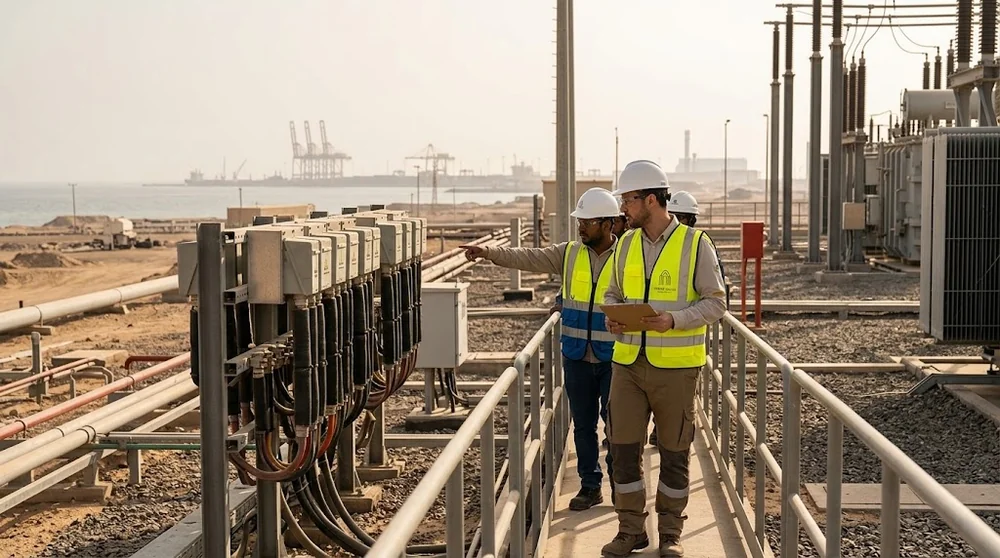
Logistics and port access
- Cargo handling: confirm that your cargo type, weight and dimensions are handled today, and with which equipment.
- Vessel services: request actual sailings and connections, since capacity is not shipping frequency.
- Storage and customs: confirm bonded or open storage and the customs arrangements with ZATCA for your goods.
- Onward haulage: price road transport to customers.
- Future services: do not treat planned rail or expanded terminal services as bookable now.
Negotiate the lease and handover conditions
The points below are for Saudi counsel and your technical advisers to review. They are negotiation requests and review items, not rights granted automatically by law, and we are not offering legal advice.
- Permitted use: match the clause to your actual process, products and storage.
- Duration and renewal: check that the term supports your equipment payback.
- Rent commencement: rent should start on a defined event, such as plot handover plus passed utility acceptance tests, not on signing. Ask whether a rent-free fit-out period applies and who bears rent while the site operator is late.
- Escalation and deposits: understand the indexation method, deposit size and release conditions. Clarify how the deposit is held, when it is returned, and whether it can be offset against rent or damages.
- Plot delivery: define the handover date, the condition of the plot and the evidence of delivery.
- Long-stop date: agree a final date by which the plot and utilities must be delivered. If it passes, you should be able to terminate, recover deposits and be released from build obligations.
- Build obligations and milestones: check what you must build, by when, and whether site-side delays extend your deadlines.
- Utility dependencies: link your obligations to the dates on which power, water and other services are actually available.
- Site acceptance: specify the tests that confirm the plot and services are fit for use.
- Delay treatment and exit: ask what remedies, extensions or exit rights apply if the site or utilities arrive late, including rent abatement, compensation for documented costs, and termination rights after a defined delay period.
- Termination and assignment: review exit triggers and whether the lease can pass to an affiliate or buyer.
- Reinstatement and disputes: check end-of-term obligations, governing law and forum.
Insist on a coordinated site-and-utility schedule before you place major equipment orders. Where construction access or power availability remains unsupported by documents, defer equipment commitments, because machinery that arrives before an energised building generates storage and financing costs instead of output.
If you want to test how far a draft site agreement protects you, a short one-to-one conversation about foreign ownership conditions and Vision 2030 project timelines can help you shape the questions you take to counsel.
Whatever route you choose, keep the lease questions and the utility schedule in one document trail so that a delay in one cannot be blamed on the other.
Build the full Oxagon relocation budget
We do not quote rents, tariffs, minimum investments or end-to-end setup durations for Oxagon, because none has been verified publicly for this article. The worksheet below is a structure for collecting your own quotations, with every cell to be filled from a written source.
| Cost item | One-off or recurring | Quote owner | Payment trigger | Uncertainty |
|---|---|---|---|---|
| Entity setup and registrations | One-off | Legal adviser | Filing | Low once scoped |
| Professional advice (legal, tax, environmental, technical) | One-off and recurring | Each adviser | Engagement or milestone | Medium |
| Lease and deposits | Recurring plus deposit | Site operator | Signing or handover | High until terms are issued |
| Civil works and construction | One-off | Contractor | Stage payments | High |
| Machinery and installation | One-off | Equipment suppliers | Order, shipment, commissioning | Medium |
| Freight and customs treatment | One-off | Freight forwarder and customs broker | Shipment and clearance | Medium to high |
| Utility connections | One-off plus recurring usage | Service provider | Connection agreement | High until charges are issued |
| Environmental controls | One-off and recurring | Environmental consultant | Design and approval | Medium |
| Recruitment and training | One-off and recurring | HR or agencies | Hire dates | Medium |
| Housing and transport | Recurring | Housing and transport providers | Occupancy | High until confirmed |
| Insurance | Recurring | Insurer | Policy start | Medium |
| Dual running | Recurring | Finance | Monthly | High |
| Working capital | Initial funding requirement, then changes as volumes ramp | Finance | Supplier deposits and inventory purchases before production; receivables as sales begin | Medium to high; depends on inventory, receivable and payable assumptions |
Working capital deserves its own assumptions. Estimate the inventory you must hold at start-up, the days customers will take to pay, the days suppliers will give you, and any supplier deposits paid before the first unit ships. Much of that cash goes out before production starts, so it is an initial funding requirement, and it then moves with your ramp-up.
A hypothetical delay calculation
The following is an illustration with invented round numbers, not an Oxagon price and not an example from our experience. Define delay cost as the incremental amount compared with your on-time baseline, and count each cost only once. Delay cost equals the number of delay months multiplied by the sum of three items: the extra monthly dual-running cost you would not have paid on time, the monthly contribution margin you lose (revenue less variable costs, with no fixed costs counted again), and the monthly financing on committed capital that is not already inside the dual-running figure. If your own inputs were 100, 250 and 50 currency units per month, a six-month delay would cost 6 × 400 = 2,400 units, before storage of idle equipment. Replace those inputs with your own quotations and test whether the business case survives.
Tax, customs and incentives
Standard Saudi tax rules apply to your entity as of November 2026, and ZATCA treatment of imports, duties and registration should be reviewed for your specific entity and goods. ZATCA publishes an income tax page that is a useful starting reference. ECZA publishes special economic zone benefits for the zones it covers, but those publications do not prove that a particular Oxagon operation qualifies. Include an incentive in your model only when you hold documentary evidence of eligibility.

Plan staffing and everyday operations
Workforce feasibility often decides a relocation more than land does. We do not promise visa quotas, exemptions or a universal localisation percentage, because requirements depend on the activity and the rules in force.
- Localisation: confirm the activity-specific requirements that apply to your sector with Saudi employment advisers.
- Qiwa and work authorisation: map hiring, contract and work-authorisation steps through Qiwa, and the lead times your employment adviser can document.
- Recruitment and training: decide what you can hire locally, what you must relocate and what training must precede production.
- Shift transport: price the daily route between housing and the plant, since commuting time shapes shift patterns.
- Housing: Oxagon Hive publicly reports capacity for up to 2,400 people, but that is not confirmed vacancy or suitability for your employees. Require current quotations and occupancy confirmation.
- Healthcare and schools: check access to healthcare and, where families will relocate, schooling.
- Maintenance and emergency response: identify contractors who can reach the site and the emergency services available for your hazard profile.
Staff who cannot be housed, transported or supported will not stay, so treat these lines as operating requirements rather than extras. We recommend building a headcount ramp that matches your commissioning schedule.
To line up your investment goals, budget and project options against the sites you are comparing, a short guided questionnaire gives you a structured starting point for the conversation.
The answers do not replace site evidence, but they help us understand which of the checks above matter most to your business.
Prepare your proposal and relocation approval
An initial approach is more useful when it arrives complete. Prepare a pack covering the items below.
- Corporate profile, ownership structure and track record.
- Activity description, products and target customers.
- Installed capacity and planned ramp-up.
- Capital expenditure range and funding source.
- Required plot area and layout assumptions.
- Process diagram, hazards and environmental outputs.
- Utility loads: electricity, water, wastewater, gases and telecoms.
- Cargo flows: volumes, cargo types, origins and destinations.
- Workforce plan by role and phase.
- Target production date and its drivers.
The workflow we recommend is an enquiry, followed by technical review, indicative terms, legal and environmental checks, binding agreements, construction, testing and production approval. This is a recommended workflow and not an official NEOM guarantee. Use the table below to decide whether to proceed.
| Gate | Go when | Defer when |
|---|---|---|
| Plot | A named, surveyed plot has a permitted use matching your process | Only general site availability is described |
| Utilities | Written capacity and dated energisation precede equipment delivery | Dates are indicative or unsupported |
| Approvals | Each permission has an authority and a route | Plot jurisdiction is unconfirmed |
| Logistics | Your cargo is handled by services bookable now | Services depend on future phases |
| Workforce | Housing, transport and hiring are quoted | Accommodation is assumed |
| Economics | The case survives your delay scenario | Key costs are unquoted |
Evidence register by gate
Keep one register and tick each document off before the gate decision. A gate with a missing document stays closed.
| Gate | Documents to hold | Owner |
|---|---|---|
| Plot | Plot reference and boundary drawing; surveyed area; written use class; geotechnical report; draft site agreement | Legal and real estate |
| Utilities | Written capacity letters; connection agreements with dates; acceptance-test protocols; tariff and connection-charge schedule | Engineering |
| Approvals | Counsel’s approvals map; MISA registration record; commercial registration; initial industrial licence; construction, fire and life safety, environmental and product approvals as applicable | Legal |
| Logistics | Written handling confirmation for your cargo; sailing schedules; customs arrangements; haulage quotations | Logistics |
| Workforce | Staffing plan by phase; housing and transport quotations; occupancy confirmation; employment adviser’s lead-time note | Human resources |
| Economics | Quotation file for every budget line; working-capital assumptions; delay scenario model; confirmation of any incentive eligibility | Finance |
Request a feasibility review. Send us your activity, required land area, utility demand, workforce, cargo flows and required production date, and our research team will help you structure the evidence for your decision. We are a real estate research and advisory agency. We cannot allocate land, grant permits or obtain incentives, and those decisions rest with the authorities and site operators concerned.
Oxagon business relocation FAQ
Can a foreign company set up a business in Oxagon?
A foreign company can explore establishing an operation in Oxagon, subject to its activity, applicable investment requirements, sector approvals and site acceptance. MISA investment registration, company formation and a site agreement serve different purposes. Confirm ownership conditions and the relevant approval route with Saudi legal advisers before committing to land, equipment or staff.
Is Oxagon ready for businesses to move in?
Oxagon has operating port infrastructure and residential facilities, while other industrial assets and services remain phased developments. Public project announcements do not establish that a particular plot is ready for production. Obtain written confirmation of site handover, utility capacity, access, environmental conditions and commissioning dates against your own operating requirements.
How do you apply for industrial land in Oxagon?
Start through NEOM’s official investment channels with a proposal describing your activity, investment scale, land requirements, utility loads, cargo flows, staffing and intended production date. Ask for the current tenant assessment process and available site options. Treat preliminary discussions as exploratory until the relevant parties document commercial terms, approvals and delivery obligations.
What licences does a manufacturer need in Oxagon?
The required approvals depend on the manufacturing activity, process, site and environmental impact. Map investment registration, commercial registration, the initial industrial establishment licence, and the separate approvals needed to build and start production, including construction, fire and life safety, environmental and any product-specific requirements, with the responsible authorities. A NEOM supplier registration or industrial lease does not replace the permissions needed to build, commission and operate a factory.
Does Oxagon offer special economic zone tax benefits?
Do not assume that incentives advertised for Saudi special economic zones apply to an Oxagon operation. Eligibility requires a current legal basis, the correct geographic and activity scope, and compliance with relevant conditions. Obtain written, entity-specific tax advice and verify any proposed relief with the competent authorities before including it in your business case.
How much does relocating a business to Oxagon cost?
There is no reliable universal relocation price because costs depend on the plot, production process, utility demand, equipment, logistics and workforce. Build a budget from current quotations covering setup, lease commitments, construction, connections, shipping, compliance, recruitment and working capital. Include dual-running costs and a delay scenario before comparing Oxagon with alternative locations.
Key takeaways for your Oxagon decision
Oxagon has real, operating port capacity and a stated programme of phased growth, and that is a meaningful starting point. Our assessment is that the relocation case still has to be proven plot by plot, with written evidence for land, utilities, approvals and handover dates.
Keep the three tracks apart: the legal entity, the site agreement and supplier onboarding. Each grants a different right, and none authorises production by itself. Ownership of a company, an incentive published for another zone, or an old capacity figure should never stand in for documents about your own plot.
Commit equipment only when the plot, utilities, approvals and commissioning schedule line up. When they do not, compare two quantified numbers: the cost of deferring (option expiry, customer penalties, lost market access) against the cost of committing too early (idle equipment, financing, dual running). Defer when the second number is larger, and proceed when the first is, because postponement is not free. We recommend using the checklist, budget worksheet, go/defer table and evidence register as the backbone of your internal approval paper.
Disclaimer: this article is general research and commentary as of November 2026. It is not legal, tax, financial or investment advice and does not guarantee approvals, incentives, site availability or returns. Figures and dates come from public statements and may change, so verify them with the relevant authorities and consult qualified Saudi legal, tax, environmental and technical specialists before making commitments.
 Real estate in Georgia
 Real estate in Montenegro
 Real estate in Cyprus
 Real estate in the UAE
 Bali Real Estate
 Real estate in Thailand
 Real estate in Spain
 Real estate in Turkey
 Real estate in Zanzibar
 +155 545 10 467
 hello@property-saudi-arabia.com
 Saudi Arabia




 Get catalogue of TOP-7 objects