 +155 545 10 467


NEOM is often described as a single futuristic city, but for an investor it is more useful to treat it as a development region containing several separate projects at very different stages. Based on our research, the right first question is not how large NEOM is. It is which specific asset exists, which legal right is being offered and what evidence supports it.
NEOM is a large development region in northwestern Saudi Arabia, backed by the Public Investment Fund and linked to Vision 2030. It includes The Line, Oxagon and Trojena, rather than one completed city. Investors must distinguish announced masterplans from delivered assets and verify project availability, ownership eligibility and contractual rights.

Illustrative image only; it does not show NEOM construction progress.
What Is NEOM, and Where Is It?
NEOM is a planned development region in Tabuk Province, northwestern Saudi Arabia, rather than one city with a single boundary and a single completion date. The region covers Red Sea and Gulf of Aqaba coastline, desert plains and mountain ranges. NEOM’s official materials reported a land footprint of approximately 26,500 km² as of October 2026. Crown Prince Mohammed bin Salman announced the project in October 2017 at the Future Investment Initiative in Riyadh. It sits within Saudi Vision 2030, the national economic diversification programme launched in 2016. The Public Investment Fund (PIF), Saudi Arabia’s sovereign wealth fund, is the project’s backer.
The Line is one urban component of NEOM, not a synonym for the whole region. Other components have industrial, tourism and hospitality functions. The table below summarises the baseline facts.
| Item | Position | Source and verification |
|---|---|---|
| Type | Development region containing several projects | NEOM official materials, verified October 2026 |
| Location | Tabuk Province, northwestern Saudi Arabia | NEOM official materials, verified October 2026 |
| Reported land footprint | Approximately 26,500 km² | NEOM official materials, verified October 2026 |
| Announcement | October 2017, Future Investment Initiative, Riyadh | Original announcement, 2017 |
| Backer | Public Investment Fund (PIF) | NEOM and PIF publications, verified October 2026 |
| National framework | Saudi Vision 2030 | Vision 2030 programme documents |
| Named components | The Line, Oxagon, Trojena, Sindalah, Magna | NEOM official materials, verified October 2026 |
The phrase world’s largest planned city appears in much NEOM coverage, but it should be read as a description rather than a verified ranking. Size comparisons depend on whether you measure a city, a region, a masterplan or completed urban area. No definitive worldwide ranking of NEOM was established in our research. NEOM is also distinct from the separate Red Sea destination and AMAALA, which are other Saudi giga-projects on the Red Sea coast and not parts of NEOM.
NEOM’s Masterplan: The Line, Oxagon and Trojena
NEOM’s masterplan divides the region into components with different economic purposes. Each one attracts different users, and therefore different kinds of investor.
The Line
The Line was announced in January 2021 as a linear urban development without conventional cars or streets. Designs released in July 2022 described a structure about 170 km long, 200 m wide and 500 m high, with mirrored façades and a long-term target of around nine million residents. The original dimensions and population target of The Line are masterplan specifications, not completed works or a guaranteed 2030 scope. As of October 2026, NEOM positions The Line as phased and demand-led. Independent media reports since 2024 have described smaller initial phases; we treat those as reports, not as confirmed official scope. Intended users include residents, employers, retailers and service providers.
Oxagon
Oxagon was announced in November 2021 as NEOM’s industrial and port city. Its economic rationale centres on the Port of NEOM, advanced manufacturing, logistics and clean energy. The most documented industrial milestone is the NEOM Green Hydrogen Company, a joint venture of ACWA Power, Air Products and NEOM, which announced financial close in May 2023. Oxagon is best understood through its port and industrial role. Renderings of an octagonal floating structure do not mean that an entire floating city exists.
Trojena
Trojena was announced in March 2022 as a mountain destination intended for year-round outdoor recreation, including skiing. Its likely participants are hotel developers, operators, leisure businesses and visitors rather than conventional residential buyers.
Sindalah and Magna
Sindalah is a Red Sea island planned as a luxury yachting and hospitality destination. Magna was announced as a coastal region along the Gulf of Aqaba on 5 June 2024, according to the Saudi Press Agency. Several of the individual destinations now grouped under Magna had been announced separately before that date; the June 2024 announcement presented them together as one region of planned tourism and residential communities. Both Sindalah and Magna depend on hospitality operators, infrastructure and visitor demand.
Each NEOM component implies a different participation route, and none of them automatically implies saleable housing. Oxagon points towards industrial leases and partnerships. Trojena, Sindalah and Magna point towards hospitality development and operation. The Line points towards urban occupiers and, potentially, future residential products that must be separately authorised.
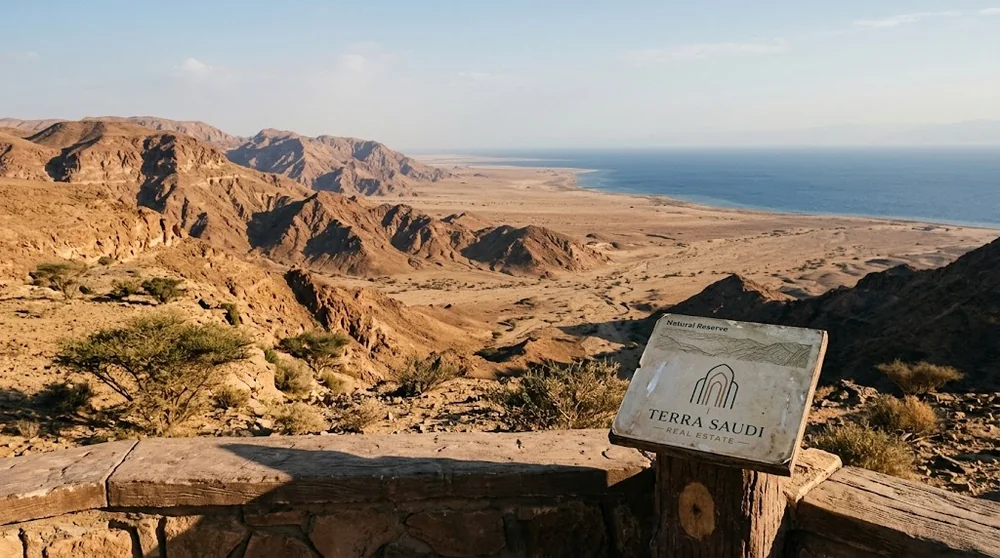
Illustrative landscape; not a photograph of a NEOM site or evidence of progress.
NEOM Progress: Announced, Built and Accessible
Announced is not the same as delivered — here’s the difference. An announcement states an intention. A signed contract or financing allocates obligations. Construction shows physical activity. Operational infrastructure is actually working. Public access means visitors or tenants can use it. Authorised inventory means a licensed seller can lawfully offer units or premises. NEOM components sit at different points on this sequence, and a single headline rarely tells you which one.
The matrix below records the evidence stage by stage. Our audit cutoff is 13 October 2026; the dates shown are the publication dates of the underlying sources, and a dash means we found no documented evidence for that stage by the cutoff, not that nothing exists.
| Component | Announcement | Contracts or financing | Construction evidence | Operational infrastructure | Public access | Authorised inventory |
|---|---|---|---|---|---|---|
| The Line | Concept January 2021; designs July 2022 | Contractor awards reported for early works | Earthworks and early works reported since 2022 | — | — | No authorised residential sales licence identified |
| Oxagon and Port of NEOM | November 2021 | Port development contracts announced | Port expansion works ongoing | Official report, July 2026: cargo unloading documented at the port | Commercial use through specific agreements | Industrial premises by agreement; no public inventory identified |
| NEOM Green Hydrogen Company | 2020 agreement | Financial close announced May 2023 | Construction stage reported by partners | Commissioning output not verified | Not applicable | Not a retail investment product |
| Trojena | March 2022 | Contracts reported for early works | Construction reported | — | Opening not documented | — |
| Sindalah | 2022 | Operator partnerships announced | Island facilities shown at unveiling | Unveiling event October 2024 | Current public booking and access not established | — |
| Magna | Region announced 5 June 2024 | Community-level details limited | — | — | — | — |
| NEOM Bay Airport | Pre-dates most components | Not applicable | Existing facility | Airport exists; current scheduled routes not verified | Depends on operator schedules | Not applicable |
The port entry deserves care. The July 2026 cargo unloading shows that the Port of NEOM is handling real activity, which matters for anyone assessing Oxagon’s industrial thesis. It does not prove that all planned terminal expansion is complete, and throughput data over time would be needed before treating the port as a mature logistics hub.
Two other milestones are often repeated in outdated form. First, Sindalah was unveiled at a high-profile event in October 2024, and some coverage presented it as open to the public. A launch event does not prove that a destination is publicly operational. By our cutoff, we had not established current public booking or access through official sources, so investors should look for live operator booking evidence or official access statements rather than relying on launch coverage.
Second, the Olympic Council of Asia (OCA) awarded the 2029 Asian Winter Games to Trojena in October 2022. Government reporting in February 2026 identified Almaty, Kazakhstan, as the replacement host, and an OCA update in July 2026 covered Almaty’s subsequent preparations. Trojena should no longer be described as the 2029 Asian Winter Games host. Any investment thesis built on that event needs to be rebuilt.
NEOM Funding and Completion Dates Explained
Funding headlines mix several different things. PIF ownership describes who backs the project. Financing facilities are loans or bonds raised for specific purposes. Partner investment comes from joint-venture participants. Project budgets apply to individual assets. Programme estimates are long-range projections. Expenditure is money actually spent. These categories should not be combined into one number.
The widely repeated USD 500 billion figure dates from the 2017 announcement. A June 2024 overview by the US International Trade Administration used a figure of USD 1.5 trillion. The USD 500 billion and USD 1.5 trillion figures come from different dates and possibly different scopes, so neither should be treated as a current audited total. We did not establish a published, audited total of NEOM expenditure as of October 2026.
| Date | Event | What it does not establish |
|---|---|---|
| October 2017 | NEOM announced; USD 500 billion headline | A current budget |
| January 2021 | The Line announced | Delivered housing |
| October 2022 | OCA awards 2029 Games to Trojena | Current host status |
| May 2023 | NEOM Green Hydrogen Company financial close | Operational output |
| June 2024 | Trade.gov overview cites USD 1.5 trillion; Magna region announced (5 June) | An audited total; delivered communities |
| October 2024 | Sindalah unveiling event | Public opening |
| February 2026 | Almaty identified as replacement 2029 host | Trojena’s opening date |
| July 2026 | OCA preparation update on Almaty; cargo unloading documented at Port of NEOM | Completed terminal expansion |
Saudi Vision 2030 is a national programme milestone, not one contractual completion date for the entire region. We have not identified a verified final completion date for NEOM, and we found no evidence of an announced public listing of NEOM itself.
How Investors Can Participate in NEOM
Most documented participation in NEOM so far is institutional or commercial. The table separates the main routes by instrument and by whether they create property rights. Foreign-entity references reflect the investment registration system under the updated Investment Law, as of October 2026.
| Route | Typical participant | Instrument | Verification channel | Establishes property ownership? |
|---|---|---|---|---|
| Corporate partnership or joint venture | Large corporations, institutional investors | Shareholder or joint-venture agreement | NEOM official business channels; MISA investment registration; commercial registration | Only if the agreement grants property rights |
| Industrial premises or lease | Manufacturers, logistics firms | Lease, usufruct or land allocation agreement | NEOM and Oxagon commercial teams; registered rights checks | Usually a leasehold or contractual right, not freehold |
| Hospitality development or operation | Hotel developers, operators | Development, management or lease agreement | NEOM tourism entities; MISA investment registration and sector licences for foreign entities | Depends on the agreement |
| Supplier or contractor | Contractors, service firms | Procurement contract | NEOM procurement registration | The contract itself does not |
| Indirect exposure | Individual or institutional investors | Listed shares, funds or bonds of related companies | Capital Market Authority (CMA) or relevant foreign regulator | No |
| Residential purchase | Eligible individuals or entities | Sale or lease contract | Real Estate General Authority (REGA); off-plan licensing where applicable | Only where an authorised offering exists and the buyer qualifies |
What this means for investors in practice: supplier registration is not an investment allocation, and equity in a NEOM-related company is not ownership of a NEOM apartment. A procurement contract earns contract revenue but does not itself establish ownership of NEOM property. A shareholder in a listed partner company carries that company’s whole risk profile, not a direct NEOM property interest. As of October 2026, we did not identify verified minimum investment amounts, public shares in NEOM itself or authorised residential inventory, so any offer claiming these should be checked against the relevant official channel before money moves.
Can Foreigners Buy Property in NEOM?
Saudi Arabia revised its rules on foreign property ownership through the Law of Real Estate Ownership by Non-Saudis. The Real Estate General Authority (REGA) confirms that the revised non-Saudi ownership framework took effect on January 22, 2026. The statutory structure is more specific than many summaries suggest. As we read the published text, as of October 2026, three articles matter most for a NEOM enquiry.
Article 2 sets the geographical scope: non-Saudis may own real estate or acquire other real rights within geographical areas designated by a Council of Ministers resolution, with stricter conditions for Makkah and Madinah. Article 3 adds two important provisions. A legally resident non-Saudi individual may, subject to conditions, own one residential property outside those designated areas, again with the holy cities treated separately. Non-Saudi companies and entities may hold real estate needed for their activity, such as premises or staff housing, under the conditions set by the law and its regulations. Article 8 ties these rights to registration, so an unregistered arrangement does not give a buyer the same protection as a right recorded in the real estate register.
The offered right matters as much as the buyer. A registered title, a registered long lease and a contractual reservation are not equivalent, and residential, commercial and investment holdings can be regulated differently. These statutory rules are general; they do not confirm that any NEOM location falls within a designated area or that any NEOM property is offered for sale. We did not verify NEOM-specific availability, so that point must be checked against the current Council of Ministers designation and REGA’s regulations for the exact location.
A common misunderstanding we see: assuming that the NEOM brand itself creates purchase eligibility. NEOM branding does not prove that a particular property is offered for sale, that the seller is authorised or that a foreign buyer qualifies. Early NEOM announcements referred to a distinct regulatory framework for the region. We have not established a published, generally applicable NEOM property regime offering freehold, tax-free ownership or independent courts to all buyers.
Company ownership is a separate matter. Under the updated Investment Law, the Ministry of Investment (MISA) states that the former investment licence has been replaced by investment registration. As of October 2026, a foreign investor typically registers the investment with MISA, then obtains commercial registration, then secures any approval required for activities on the restricted list and any sector-specific licences from the competent authorities. Those steps permit business activity; they do not automatically entitle the company to acquire a specific property, which remains subject to the ownership law above. Property acquisition is also separate from immigration. Owning or leasing property does not by itself grant residency, and residency programmes such as Premium Residency have their own criteria.
We recommend checking four points with REGA and an independent Saudi lawyer: your buyer category, whether the exact location falls within a designated area, the registered right being offered, and the seller’s authority to grant it.
NEOM Property Due-Diligence Checklist
The checklist below applies to any NEOM-related property or premises offering. Not every protection listed applies automatically; each must be confirmed for the specific transaction.
- Identify the exact asset. Obtain the parcel, unit or premises reference, its location within a named component and its approved use.
- Establish the title or offered right. Confirm whether you would receive registered ownership, a registered lease, a usufruct right or only a contractual reservation.
- Search encumbrances and competing rights. Check the register for mortgages, liens, restrictions, competing interests and any disputes or court proceedings affecting title.
- Identify the seller and signatory. Confirm the legal entity, its commercial registration, its relationship to the landowner or developer and the authority of the person signing on its behalf.
- Confirm buyer eligibility. Check your category under the Law of Real Estate Ownership by Non-Saudis and current REGA regulations.
- Separate the developer’s permissions. Developer qualification, permission to market a project and permission to sell or lease off-plan are different approvals; confirm each one for this specific project.
- Check off-plan licensing and escrow. Where units are sold before completion, confirm the project-specific off-plan licence under REGA’s off-plan framework and whether payments go into a regulated escrow account.
- Verify the payment recipient. Confirm that the account named in the contract is the authorised project account, and never pay to an individual or an unrelated entity.
- Review the contract. Have the sale or lease agreement reviewed in both Arabic and English, noting which version prevails.
- Examine payment milestones. Link each payment to a verifiable construction stage rather than to calendar dates alone.
- Define completion. Confirm how completion and handover are defined, inspected and certified.
- Test delay remedies and refunds. Identify compensation, termination rights and refund conditions if delivery slips.
- Confirm utilities and access. Check contractual commitments for power, water, telecoms, roads and transport links.
- Review operating charges. Request service charge budgets, management arrangements and any restrictions on use or letting.
- Test financing. Confirm whether Saudi or foreign lenders will finance this asset type and right.
- Check assignment rights. Establish whether you can transfer the contract before completion and at what cost.
- Clarify disputes. Identify governing law, the competent court or arbitration forum and enforcement routes.
- Plan the exit. Confirm resale restrictions, buyer eligibility for future purchasers and any disposal charges.
We recommend independent Saudi legal and technical review before any payment, including reservation deposits. A technical adviser can assess construction status and infrastructure dependencies, while a lawyer can confirm title, encumbrances, authority and contractual remedies.
Have a specific NEOM offer in front of you? Send the details to Sophia and the Saudi research team on WhatsApp and we will tell you which documents to request first.
Those two reviews address different risks, and neither replaces the other. In anonymised cases we have reviewed, the gap is usually the same: a reservation form that names a project but not a registered right, an account holder or an off-plan licence.

Illustrative image only.
NEOM Prices, Returns and Total Costs
No representative NEOM-wide residential price, rent, yield or resale market was established in our research as of October 2026. We found no official transaction dataset for NEOM residential property comparable with the data available for established Saudi cities. Any price per square metre, yield or occupancy rate presented for NEOM should therefore be checked for its basis. An asking price is what a seller requests. A completed transaction is a registered sale. A forecast is a projection. An illustrative calculation is a model built on assumptions. Only completed transactions show what buyers actually paid.
A full cost picture should include:
- Acquisition consideration and any reservation deposit
- Applicable transaction taxes, after confirming liability and exemptions
- Legal, technical and valuation review fees
- Financing costs, including arrangement fees and interest
- Fit-out and furnishing
- Insurance
- Service charges and community fees
- Property management and letting fees
- Any fee on a non-Saudi’s disposition of real rights under the ownership law
- Disposal costs, including brokerage and any transfer charges
On taxes, the Zakat, Tax and Customs Authority (ZATCA) states a general Real Estate Transaction Tax (RETT) rate of 5%, as of October 2026, subject to exemptions. RETT is distinct from Value Added Tax (VAT), which may apply to related services such as brokerage or management.
RETT is also distinct from the fee in Article 9 of the Law of Real Estate Ownership by Non-Saudis. That article provides for a fee on a non-Saudi’s disposition of real rights, with a statutory ceiling of 5% of the transaction value, as of October 2026. It is a separate potential charge, not a second automatic 5% to add to every acquisition. The applicable amount, exemptions and which transactions it covers must be confirmed against current implementing regulations for your specific deal before it goes into a model.
A transparent calculation framework works in three steps, using only verified inputs:
- Total acquisition cost equals price plus verified taxes, fees, financing and fit-out.
- Net annual income equals verified rent minus service charges, management, insurance, maintenance and expected vacancy.
- Net yield equals net annual income divided by total acquisition cost.
Where inputs cannot be verified, the honest result is that the yield cannot yet be calculated.
NEOM Investment Risks and Evidence to Monitor
The register below sets out each risk, how it works and what to monitor. Risks differ between components, so not every item applies equally to every asset.
- Financing and reprioritisation: Capital may be redirected between components or national projects. Monitor PIF annual reports and official NEOM announcements on phasing.
- Construction and infrastructure dependencies: An asset’s value depends on roads, utilities and transport that may be delivered separately. Monitor contractor award announcements and utility commissioning statements.
- Tenant or visitor demand: Demand-led phasing means occupancy assumptions are uncertain. Monitor published visitor, employment and occupancy data once available.
- Operating costs: Remote locations and advanced building systems can raise service charges. Monitor actual service charge statements from completed assets.
- Liquidity: Without a resale market, exiting may take time or require a discount. Monitor registered secondary transactions.
- Regulatory change: Ownership regulations and designated areas may be revised. Monitor REGA regulations and notices.
- Environmental impacts: Renewable-energy and conservation commitments are targets unless measured outcomes are published. Monitor independently verified environmental reporting.
- Community issues: Human rights organisations and international media have reported allegations concerning the relocation of local residents. Review those reports alongside any official responses and assess reputational exposure.
- Governance: Leadership changes and reorganisation can shift priorities. Monitor official appointment announcements and project restructuring notices.
The weight of each risk changes with the asset. An industrial lease near an active port faces different questions from an off-plan apartment in a phase with no published schedule.
Team assessment (opinion, not advice): In our assessment, the most material risk for an individual buyer is usually the combination of delivery uncertainty and limited exit evidence, rather than any single headline. That view rests on the absence of market data as of October 2026, not on a prediction about specific projects.
NEOM Compared With Riyadh and Jeddah
Riyadh and Jeddah are established urban markets, while NEOM is a phased development region. The difference is easiest to see in the evidence each one produces. For the two cities, official sources publish dated market data: the General Authority for Statistics (GASTAT) issues a quarterly Real Estate Price Index broken down by region, including Riyadh Region and Makkah Region (where Jeddah sits), and by residential, commercial and agricultural sectors. Registered sale transactions by city and property type are published through the national Saudi real estate platform. We found no equivalent NEOM residential series as of October 2026.
| Criterion | Riyadh | Jeddah | NEOM |
|---|---|---|---|
| Existing stock | Large completed residential and commercial stock | Large completed stock | Limited completed stock; varies by component |
| Transaction evidence | Registered transactions by property type; GASTAT index for Riyadh Region | Registered transactions by property type; GASTAT index for Makkah Region | No residential transaction series identified |
| Tenant demand | Observable from existing occupiers | Observable from existing occupiers | Industrial demand partly observable around the port; residential and hospitality demand largely projected |
| Infrastructure | Operational, with ongoing expansion | Operational, with ongoing expansion | Port activity documented July 2026 and an existing airport; most other infrastructure planned or under construction |
| Eligibility verification | Check designated areas under current REGA rules | Check designated areas under current REGA rules | Check designated areas, offered right and seller authority |
| Management | Established management market | Established management market | Arrangements asset-specific and less proven |
| Exit evidence | Observable resale activity | Observable resale activity | Not established for residential assets |
Riyadh and Jeddah offer more observable evidence, but that does not make them universally safer; each asset still needs its own review. For a city asset, a research-stage investor would need comparable registered transactions for the same district and property type, rental evidence and confirmation of eligibility.
Not sure whether a city asset or a NEOM-related route fits your situation? Take our short investor quiz to see which questions apply to your buyer category and budget.
For a NEOM asset, the same investor would also need proof of delivery status for the specific component, infrastructure commitments in the contract and a credible exit route. An Oxagon industrial lease and a future residential unit on The Line should never be assessed with the same evidence.
NEOM Investor FAQ
Is NEOM the same as The Line?
NEOM is the wider development region, while The Line is one urban component within it. Other components have different industrial, tourism and hospitality functions. Investors should identify the exact development and legal instrument involved because a regional masterplan does not establish that a particular apartment, land parcel or investment product is available.
When will NEOM be completed?
NEOM does not have one completion date covering every development. Different components follow separate planning, financing and construction schedules, and those schedules can change. Saudi Vision 2030 is not a guarantee that the entire region will be finished by 2030. For an investment decision, check the relevant asset’s contractual milestones and latest documented progress.
Can foreigners buy property in NEOM?
A foreign buyer must establish eligibility under the Law of Real Estate Ownership by Non-Saudis, in force since January 2026, and confirm that the exact property sits within a designated area or qualifies under another provision, such as the single-residence rule for legal residents. As of October 2026, NEOM branding alone does not prove purchase eligibility or sale availability. Check current REGA requirements, registered rights and the seller’s authority with an independent Saudi lawyer.
How can an individual invest in NEOM?
An individual first needs to identify a genuine, authorised investment offering rather than assume that NEOM itself is a standard retail product. A property purchase, fund holding and company investment create different rights and risks. Verify the issuer or seller, regulatory permissions, underlying exposure, costs and exit terms before committing money.
Is NEOM a good investment compared with Riyadh or Jeddah?
Suitability depends on the specific asset, available evidence, investor eligibility and tolerance for delivery and liquidity risks. Compare completed stock, registered transactions, tenant demand, operating costs and exit options using consistent criteria. Regional publicity cannot establish expected returns. Where NEOM-specific market evidence is unavailable, state that limitation instead of substituting forecasts for observed results.
Conclusion
NEOM is a development region, not a single finished city, and its components sit at very different stages as of October 2026: the Port of NEOM shows documented activity, the hydrogen project has reached financial close, and most residential and hospitality assets remain at the announced or construction stage. The value of any NEOM opportunity therefore lies in one specific asset, one registered right and one authorised seller, never in the regional brand.
Before commissioning further research, define your intended route, your buyer category, your budget range, your time horizon and the exact offering you are considering. With those points clear, you can request a project-specific evidence review from Sophia and the Saudi research team; it organises the documents, milestones and regulatory checks for that offering, but it does not establish availability, regulatory approval or returns. Before any commitment, we recommend engaging independent Saudi legal, tax, technical and investment specialists for your specific transaction.
Disclaimer: This article is for educational information only and reflects research as of October 2026. It is not legal, tax, financial or investment advice, and it does not guarantee the availability, completion or performance of any project or asset.
 Real estate in Georgia
 Real estate in Montenegro
 Real estate in Cyprus
 Real estate in the UAE
 Bali Real Estate
 Real estate in Thailand
 Real estate in Spain
 Real estate in Turkey
 Real estate in Zanzibar
 +155 545 10 467
 hello@property-saudi-arabia.com
 Saudi Arabia




 Get catalogue of TOP-7 objects